
Maldives Real Estate Investment Report 2026: ROI, Capital Gains, and Future Trends
Maldives Real Estate Investment Report 2026: ROI, Capital Gains, and Future Trends
For the savvy global investor, 2026 represents a pivotal year for Maldives real estate. While the world’s traditional property hotspots—London, New York, and Hong Kong—grapple with stagnating yields and high taxation, the Maldives has emerged as a high-performance alternative. But what are the actual numbers? What is the real ROI on a multi-million dollar water villa?
This report provides an in-depth analysis of the investment landscape in the Maldives for 2026. We examine rental yields, capital appreciation, the impact of infrastructure projects, and a head-to-head comparison with other luxury markets like Dubai and the Seychelles.
The “Branded Residence” Revolution
The biggest trend in Maldives real estate leading into 2026 is the explosion of “Branded Residences.” International hotel brands (such as Ritz-Carlton, Four Seasons, and Soneva) are no longer just selling room nights; they are selling title deeds.
For an investor, buying a branded villa is a “de-risking” strategy. A brand brings a global database of loyal guests, professional management, and a high level of maintenance that preserves the asset’s value. In 2026, branded residences in the Maldives are commandingly higher resale premiums—often 20% to 30% higher than unbranded luxury properties.
ROI Analysis: Breaking Down the Rental Pool Math
Most luxury property in the Maldives is operated through a “Rental Pool” system. As an owner, you typically have a set number of days for personal use (usually 14 to 30 days), and the rest of the year, the resort rents out your villa. Here is the realistic 2026 ROI breakdown:
1. Gross Rental Yields
Luxury villas in top-tier atolls currently see Average Daily Rates (ADR) ranging from USD 2,500 to USD 8,000. In a well-managed resort with an occupancy rate of 65% to 70%, the gross annual revenue for a single villa can easily exceed USD 600,000.
2. The Revenue Split
In 2026, the standard revenue split in the Maldives is 50/50 or 60/40 in favor of the owner. Out of the resort’s share, they typically cover marketing, housekeeping, and guest services. Out of the owner’s share, you may be responsible for a “Furniture Replacement Fund” (usually 3% to 5%) and structural insurance.
3. Net ROI
After all expenses, investors in Maldives real estate are seeing net cash-on-cash yields of 7% to 11%. This is significantly higher than the 2% to 3% net yields commonly found in European luxury coastal markets.
Maldives vs. Dubai vs. Seychelles: The 2026 Comparison
To understand why capital is flowing into the Maldives, we must compare it to its nearest competitors:
- Dubai: While Dubai offers high yields, the market is prone to massive oversupply. In contrast, the Maldives has a “natural supply cap”—there are only so many islands. Scarcity drives value.
- Seychelles: The Seychelles offers freehold options but has a much slower tourism growth rate and lower ADRs than the Maldives. The Maldives’ infrastructure in 2026, including the expanded international airport, far outpaces the Seychelles.
- The Caribbean: High insurance premiums due to hurricane risks often eat into Caribbean profits. The Maldives, located outside the major cyclone belt, enjoys a more stable climate for property insurance.
Infrastructure: The Invisible Value Driver
Smart investors don’t just look at the villa; they look at the airport. The completion of the Velana International Airport (VIA) expansion has changed the game for Maldives real estate.
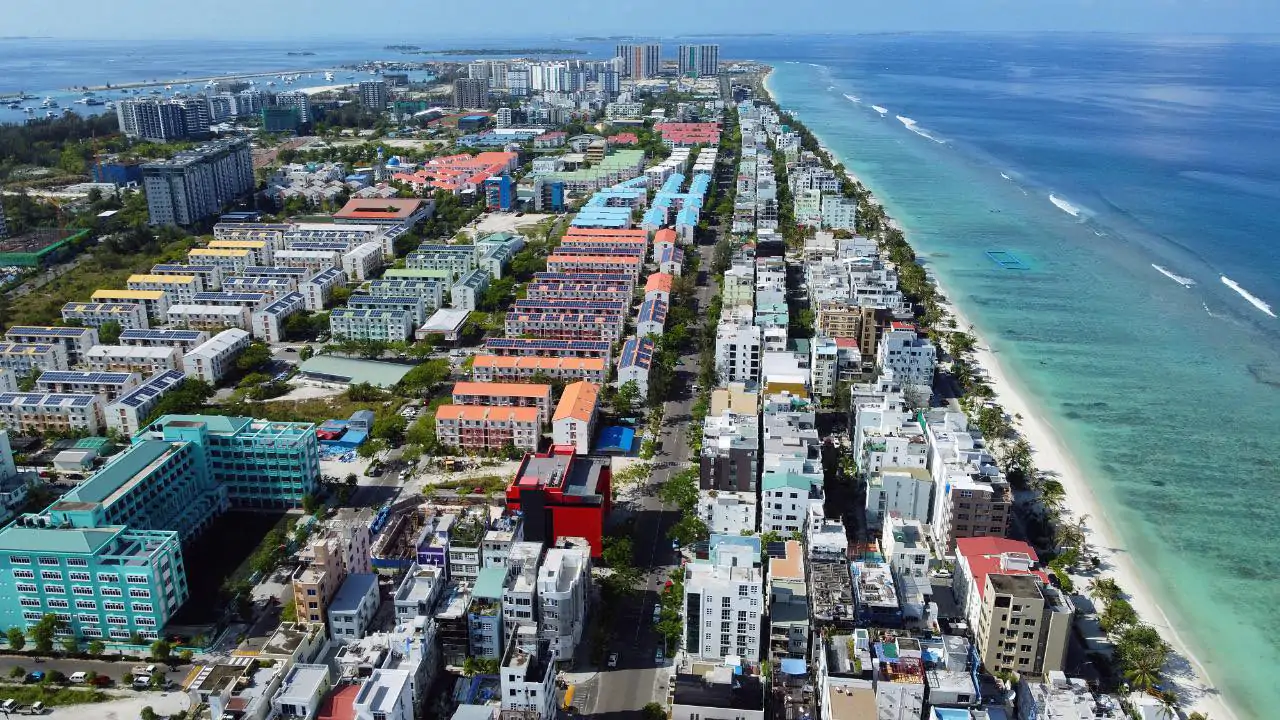
The ability to handle 7.5 million passengers annually means that resorts in the “Secondary Atolls” (those requiring a seaplane) are now seeing higher occupancy rates. Furthermore, the bridge connecting Malé, Hulhumalé, and Thilafushi has turned the Greater Malé region into a unified economic hub, driving up the value of residential apartments in Hulhumalé Phase 2.
The Climate Resilience Factor: Myth vs. Reality
A common concern for investors is the long-term viability of the islands due to sea-level rise. However, in 2026, the Maldives is leading the world in “Land Reclamation Technology.”
Newer developments are being built at higher elevations (3 meters+ above sea level), and projects like the Maldives Floating City prove that the nation is innovating its way out of climate risks. Investors are now viewing Maldivian engineering as a blueprint for the future, which has stabilized long-term confidence in property values.
Exit Strategies: How to Liquidate Your Asset
An investment is only as good as your ability to sell it. In 2026, the secondary market for Maldives real estate is more liquid than ever before.
- Internal Resale: Many resorts have a “Right of First Refusal,” where they will buy the villa back from you at market value.
- Global Portals: High-end villas are now frequently traded on luxury platforms in Singapore, Dubai, and London.
- The Strata Advantage: Because of the Strata Act (which we explained in our Legal Guide to Buying in the Maldives), transferring ownership of a single unit is now as simple as a standard leasehold transfer, taking weeks instead of months.
Conclusion: Is the Maldives the Right Move for Your Portfolio?
The Maldives is no longer a “speculative” market; it is a “mature” luxury market. With 2026 projections showing continued growth in tourism arrivals and a tightening of environmental building codes, the supply of available villas is only going to become more restricted.
If you are looking for an asset that provides a USD-denominated income stream, a hedge against global inflation, and a world-class holiday home, the time to enter the market is now.
Ready for a Private Consultation?
As leaders in Maldives real estate, we provide full-service investment brokerage and ROI modeling.
View Our 2026 Investment Portfolio Here
Comments